


USMLE ADHD Accommodations Personal Statement
We offer USMLE ADHD accommodations personal statement professional writing and editing on NBME’s history, current functioning, and rationale.
In your USMLE personal statement, the focus is on explaining how your impairment limits you and why each accommodation you are asking for is necessary.
Our experts structure your personal statement for accommodations around the history, current functioning, and rationale for accommodations.
While there is no required length, we ensure that your comprehensive statement ranges between two to three pages.
How We Write Your USMLE ADHD Accommodations Personal Statement
The National Board of Medical Examiners (NBME), which administers accommodations for USMLE, requires a personal statement in three concise sections, which should be written concisely. Our professional writers understand that a personal statement is the foundation of your application. What we mean by this is that your evaluation proves the ADHD diagnosis, your records prove the history, and the personal statement is where we explain what the numbers feel like from the inside and why the accommodation you are requesting fixes those barriers.
NBME Personal Statement Prompt 1: History
In the history section of your ADHD personal statement, our writers explain when the symptoms first appeared, when you were officially diagnosed, how the impairment impacted your daily life and schooling over time, and the accommodations you have received before.
NBME Personal Statement Prompt 2: Current Functioning
The focus in the current functioning section of your personal statement is where our experts explain the manner in which ADHD limits you right now, compared with most people in academic, concentration, reading, thinking, work, social, and everyday settings. Our personal statement for accommodation writers ensures that the document is concrete and current.
NBME Personal Statement Prompt 3: Rationale for Accommodations
In this section, our writers explain the accommodations you are requesting and why each is essential to make the USMLE accessible.
ADHD and Request for Extended Time Accommodations Personal Statement Sample
This sample is based on fictional information and is intended to be fully personalized; it aims to provide an overview of what a personal statement should contain.
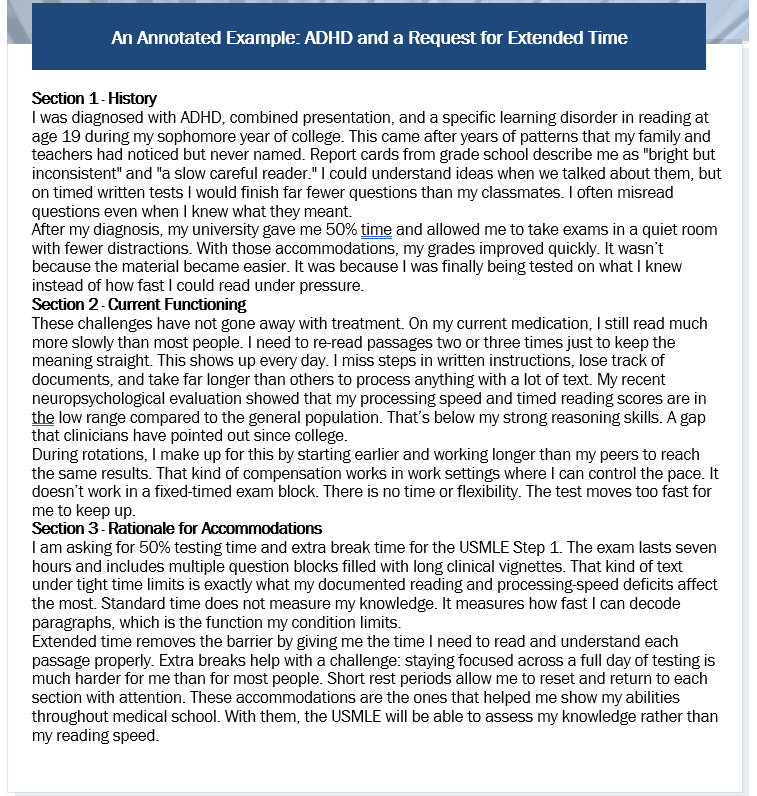
An Annotated Example: ADHD and a Request for Extended Time
Section 1 · History
I was diagnosed with ADHD, combined presentation, and a specific learning disorder in reading at age 19 during my sophomore year of college. This came after years of patterns that my family and teachers had noticed but never named. Report cards from grade school describe me as “bright but inconsistent” and “a slow careful reader.” I could understand ideas when we talked about them, but on timed written tests I would finish far fewer questions than my classmates. I often misread questions even when I knew what they meant.
After my diagnosis, my university gave me 50% time and allowed me to take exams in a quiet room with fewer distractions. With those accommodations, my grades improved quickly. It wasn’t because the material became easier. It was because I was finally being tested on what I knew instead of how fast I could read under pressure.
Section 2 · Current Functioning
These challenges have not gone away with treatment. On my current medication, I still read much more slowly than most people. I need to re-read passages two or three times just to keep the meaning straight. This shows up every day. I miss steps in written instructions, lose track of documents, and take far longer than others to process anything with a lot of text. My recent neuropsychological evaluation showed that my processing speed and timed reading scores are in a low range compared to the general population. That’s below my strong reasoning skills. A gap that clinicians have pointed out since college.
During rotations, I make up for this by starting earlier and working longer than my peers to reach the same results. That kind of compensation works in work settings where I can control the pace. It doesn’t work in a fixed-timed exam block. There is no time or flexibility. The test moves too fast for me to keep up.
Section 3 · Rationale for Accommodations
I am asking for 50% testing time and extra break time for the USMLE Step 1. The exam lasts seven hours and includes multiple question blocks filled with long clinical vignettes. That kind of text under tight time limits is exactly what my documented reading and processing-speed deficits affect the most. Standard time does not measure my knowledge. It measures how fast I can decode paragraphs, which is the function my condition limits.
Extended time removes the barrier by giving me the time I need to read and understand each passage properly. Extra breaks help with a challenge: staying focused across a full day of testing is much harder for me than for most people. Short rest periods allow me to reset and return to each section with attention. These accommodations are the ones that helped me show my abilities throughout medical school. With them, the USMLE will be able to assess my knowledge rather than my reading speed.
Writing an NBME Personal Statement After Denial
If your request is denied, the NBME allows one reconsideration per active registration, and it must include new information. If you have received a denial letter, we can help you work on your statement; we do not rewrite from scratch; rather, we work backward from the denial letter. We begin by understanding the reasons for the denial, then address each denial reason by explaining the new evidence that addresses the raised concerns.
Talk to us today and let us know how our writers can help with your personal statement for accommodation.
